
Renewed Reverence: The Madonna of Carafa Emerges After Restoration
PRESS RELEASE
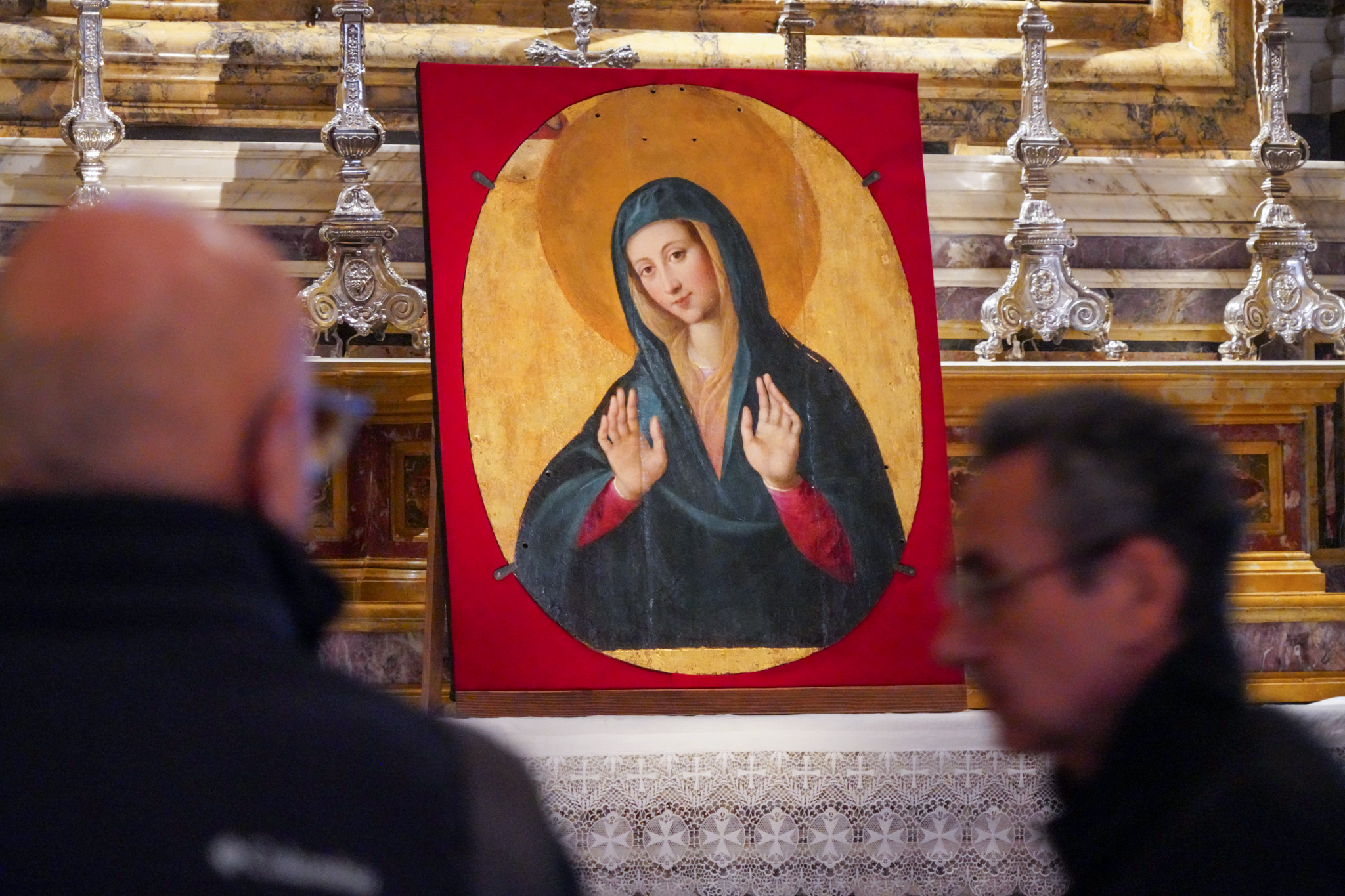
The revered Madonna of Carafa, long cherished yet little known, has emerged renewed after an intensive restoration and now takes pride of place at St John’s Co-Cathedral for a limited period of veneration, especially during the Marian celebrations on the 8th of December before being put back in the Chapel of Philermos. The cathedral’s in-house conservator-restorers worked with precision, not only reviving the icon’s original splendour but also uncovering new insights into a work that has, until now, remained shrouded in mystery.
Commander Frà Giangirolamo Carafa, Prior of Barletta, is known to be the commissioner of this piece, and its historical context situates the work in Southern Italy between the sixteenth and seventeenth centuries. Adopting a multidisciplinary approach gave this project far greater depth. Art historical research, technical conservation, and scientific expertise, brought together by researchers, conservators, and diagnosticians, transformed the restoration into a cognitive and investigative journey, one that not only ensured the safeguarding of the work but also deepened our understanding of its historical and cultural context.
The icon’s journey begins in Southern Italy, on the hills overlooking Matera, at the Sanctuary of the Madonna of Picciano. The sanctuary was an ancient foundation of Benedictine and later Hospitaller origin, and its Marian image has been at the heart of popular devotion for centuries. In 1601, Frà Giangirolamo Carafa, the Commander of Santa Maria di Picciano between 1592 and 1615, commissioned a replica of the icon for his private devotions, moved by the faith of the local population and the miracles reportedly witnessed at the sanctuary.
Carafa subsequently took this copy, which became known as the Madonna of Carafa, with him to Malta. The image was later exposed for public veneration in the Chapel of Our Lady of Victories in Valletta. Per his will, on November 23, 1622, this icon was hanged above the altar of St Catherine in the Chapel of Italy within the St John’s Co-Cathedral. The Council’s record at the time emphasised the obligation to ensure “the veneration due to the sacred image”. The icon remained there until 1954, when it was transferred to its current location, the Chapel of the Blessed Sacrament also known as the Chapel of the Virgin of Philermos.
Targeted diagnostic analyses, including multispectral imaging, X-ray radiography, and CT scan, were crucial to the investigation. The analyses confirmed that the icon is executed on three poplar wood planks joined together to create an oval format. The structure is reinforced on the reverse by three horizontal crossbars, which are considered original to the work. The absence of a joint system and full canvas lining (incamottatura) contributed to deformations over time, necessitating later fillings and structural additions. Findings about the paint layers confirmed a late Renaissance and Mannerist palette. This analysis detected the presence of the original pigments and overpainting dated to later historical interventions.
At the time of restoration, the icon was in a precarious state, having suffered from insect damage, yellowed protective varnish, and widespread overpainting. The primary objective of the restoration was to preserve the physical and structural integrity of the work. The intervention focused on: structural consolidation and treating the wood against woodworm infestation; selective cleaning and removal of oxidised varnish and recent overpainting’s; and chromatic reintegration, which followed the principle of reversibility, achieving uniform colour without compromising the legibility of the original image.
The meticulous restoration, concluded in October 2025, was guided by material evidence and sought to stabilise, protect, and enhance the work without overriding its identity. Having survived centuries of vicissitudes, the Madonna of Carafa retains its expressive power, particularly in the face of the Virgin, whose composure and spiritual depth continue to exert a powerful devotional impact.
The Madonna of Carafa was on display from 26 November to 5 December, offering a rare opportunity to admire this restored masterpiece up close before she was moved to the High Altar on 5 December for the Marian celebrations on 8 December, and then transferred to the Chapel of the Madonna of Philermos on 10 December.